
Hi, I am Sander Borst,

I am a software developer at Eneco, where I build optimization software for digital twins to help accelerate the energy transition. I currently work mainly in Python, but I'm comfortable across languages and paradigms, and pick the tool that fits the problem.

My background in mathematics and theoretical computer science shapes how I build software: I like to understand a problem’s structure first, then turn that insight into code that is fast, correct and maintainable.

Before Eneco, I was a postdoc in the Algorithms and Complexity group at the Max Planck Institute for Informatics in Saarbrücken, and did my PhD in the Networks & Optimization group at Centrum Wiskunde & Informatica in Amsterdam, advised by Daniel Dadush. My research is on online algorithms, which make good decisions before the full input is known, including:

I hold degrees in mathematics and computer science from Delft University of Technology.

Publications
Beyond the Half-Approximation: Fair and Efficient Online Class Matching
Sander Borst, Max Springer
2026
Improved Online Load Balancing in the Two-Norm
Sander Borst, Danish Kashaev
2025
To buy or not to buy: deterministic rent-or-buy problems on node-weighted graphs
Sander Borst, Moritz Venzin
2025
Stronger adversaries grow cheaper forests: online node-weighted Steiner problems
Sander Borst, Marek Eliáš, Moritz Venzin
2024
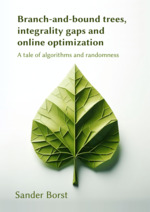
Branch-and-bound trees, integrality gaps and online optimization : a tale of algorithms and randomness
Sander Borst
2024
Online Matching on 3-Uniform Hypergraphs
2024
Certified Constraint Propagation and Dual Proof Analysis in a Numerically Exact MIP Solver
Sander Borst, Leon Eifler, Ambros Gleixner
2024
A nearly optimal randomized algorithm for explorable heap selection
2022
Integrality Gaps for Random Integer Programs via Discrepancy
2022
A multidimensional solution to additive homological equations
Aleksei Ber, Matthijs Borst, Sander Borst, Fedor Sukochev
2021
On the Integrality Gap of Binary Integer Programs with Gaussian Data
2020
Majorizing Measures for the Optimizer
2020
New FPT algorithms for finding the temporal hybridization number for sets of phylogenetic trees
2020